
 My Page
Pets
This information is for customers flying with pets.
Important information
At AIRDO, we take every precaution to ensure that your beloved pets, whom you regard as part of your family, are comfortable during the flight. However, the transport environment, which differs from their daily lives, can have a variety of effects on the health of pets, with the potential to cause illness, injury, or death. Please be sure to review the following precautions and consider them carefully.
Please note that AIRDO shall not be held liable if a pet dies or is injured during transport due to the pet's own health conditions and predispositions (including effects caused by atmospheric pressure, temperature, humidity, or noise), the pet's inherent temperament, or inadequate container preparation.
Pets allowed on AIRDO flights include dogs, cats, small birds, and small animals (squirrels, hamsters, etc.).
- Notes:
-
- We do not allow birds of prey (eagles, hawks, owls, etc.) on flights.
• Please consult with your veterinarian to ensure that your pet has received the appropriate vaccinations. For dogs, please ensure they have received the vaccinations required by the Rabies Prevention Act within the past year.
• There is limited space in the cargo hold. Depending on how much other cargo is being loaded, we might be unable to accept your pet. In that case, we would ask you to change your flight.
• Some large pet cages might be too large to load onto an airplane. Please contact us in advance regarding the size of your cage.
Pets in the following health conditions cannot be transported:
- Your pet is not in a condition fit for air travel.
- Your pet is pregnant.
- Your pet is very young (less than four months old).
- Your pet has a heart problem or a respiratory disease.
We strongly advise that you consult with a veterinarian before flying with a pet if any of the following conditions apply:
- Your pet is not accustomed to being separated from you for long periods of time.
- Your pet is not accustomed to staying in a pet cage for long periods of time.
- Your pet is a short-nosed dog breed.*
- Your pet has a medical condition.
※During the summer season (May 1-Oct 31), we do not accept short-nosed dog breeds on board, as these dogs are more sensitive to high temperatures than other breeds and are at risk of heatstroke and breathing difficulties.Please click here to view the list of affected breeds.
Your pet will be carefully loaded into the cargo hold (bulk cargo compartment) of the airplane. The environmental conditions inside the hold are as follows.
Temperature and humidity:
Although our airplanes use air conditioning to regulate temperature and humidity in the cargo hold, the environment may differ from that of the passenger cabin due to factors such as the outside temperature. In particular, during the summer, the cargo hold may become hot due to the ambient temperature and radiant heat. Additionally, since boarding and deplaning take place outdoors, there may be significant fluctuations in temperature and humidity during the summer and winter.
Lighting:
The lights are turned off during flight, so it will be dark inside the cargo hold.
Sound:
The sounds of machinery operating and noise from the wind can be heard during take-off/landing and while in flight. The sounds of the aircraft as well as vehicles on the tarmac can also be heard when boarding and exiting the airplane.
To minimize your pet's anxiety and stress, please carry out the necessary preparations in advance.
Installing a drip-bottle water dispenser:
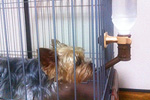
To protect your pet against heatstroke and dehydration and to help your pet calm down when agitated, you will need to install a drip-bottle water dispenser on the pet cage.
- Notes:
-
- Attach the dispenser firmly to the cage with the lid tightly secured to prevent leaks.
- Only drip-bottle dispensers are allowed. AIRDO does not accept water bowls due to the risk of water being spilled.
Dealing with hot and cold temperatures:
- In summer, bring something for cooling your pet, such as a cooling mat or cold packs. In winter, bring a blanket or disposable warming pads for pets.
- Since indoor cats and dogs often have thick undercoats, we recommend grooming their undercoats before traveling during the summer.
Pets may experience anxiety if they notice changes in their owner's behavior. As the time to leave on your trip approaches, try to interact with your pet as you normally would to put them at ease.
Food:
Motion sickness and other health-related issues can occur if your pet is either too full or too hungry. Please make sure that your pet is given the proper amount of food and water. Additionally, pets cannot eat while they are in the cargo hold, so make sure they have finished eating beforehand.
Pets sometimes become ill due to changes in their environment. If you notice any of the following symptoms, we recommend that you have your pet examined by a veterinarian.
Diarrhea / vomiting / rapid breathing / shivering / loss of appetite / reluctance to go for walks or go outside / persistent anxiety / any other unusual behavior ...etc.
Pet fees
You will be charged a fee for your pet to be taken aboard, regardless of whether or not a pet cage is used.
Pet fee for one pet cage on one flight route: JPY 6,600 (tax included)
- Notes:
-
- Inform the staff of the information regarding the checking of your pet(s) at the time of the boarding procedure, and pay the pet fee at the pet check-in counter.
Pet check-in and retrieval process
This page provides information on how to check in and retrieve your pet at the airport on the day of departure.
Please carry out the boarding procedure for yourself first. (Online check-in is available starting 24 hours prior to departure.)
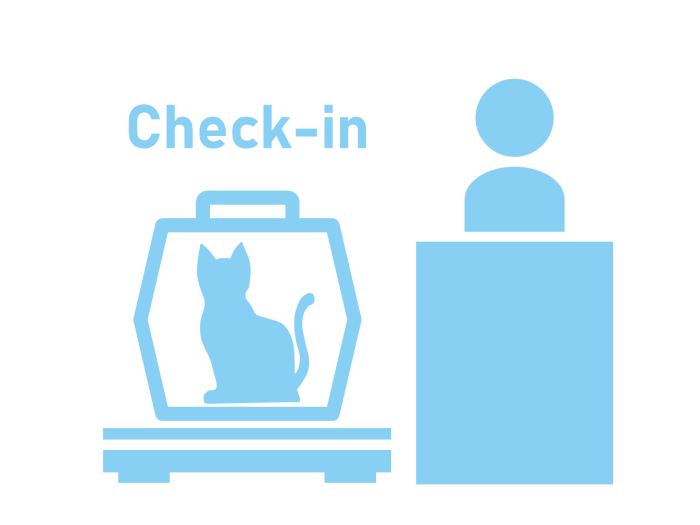
You can check in your pet at the baggage counter. Please do so at least 30 minutes prior to departure time.
- Please pay the pet fee. (You may pay by cash or credit card.)
- You will need to submit the consent and release form. Please download the consent and release form in advance, print it out on your own printer, and fill it out.
Consent and release form (274 kB)
- Notes:
-
- This process takes longer than normal check-in procedures, so please arrive early.
- Your pet might relieve itself inside the pet cage due to stress caused by a long trip or changes in its environment. Please take your pet for a walk or provide an opportunity for it to relieve itself before you come to the baggage counter.
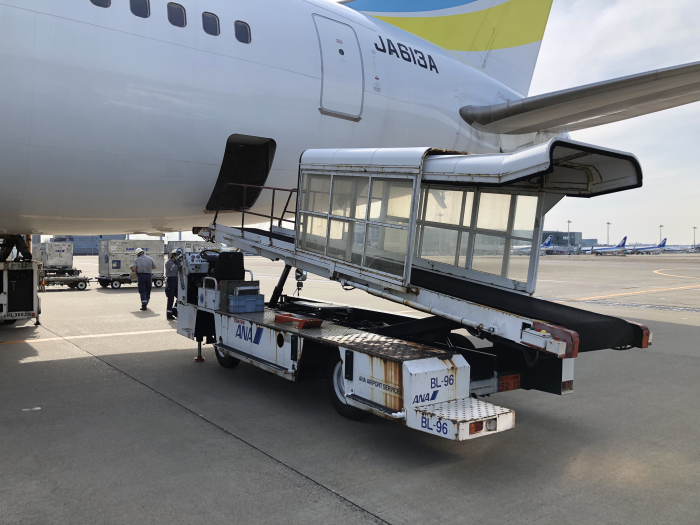
Your pet will be kept in an air-conditioned area until boarding time. After that, our personnel will carefully transport your pet by vehicle or other means and load it securely into the airplane's cargo hold (bulk cargo compartment).
Temperature fluctuations in summer and winter:
Transportation to the airplane and the loading and unloading of your pet on and off the airplane will take place outdoors. As a result, significant fluctuations in temperature and humidity may occur during summer and winter.
Temperature and humidity control by means of air-conditioning equipment:
Although the cargo hold is temperature and humidity-controlled by air conditioning equipment, its conditions may differ from those in the passenger cabin due to the outside temperature and other factors.
After the aircraft arrives, our personnel will carefully retrieve your pet from the cargo hold and will hand it over to you directly.
Important information related to summer and winter travel
In summer, the temperature and humidity can be high, and in winter, the temperature can drop below the freezing point. Due to these harsh temperature environments, we would ask you to pay attention to the following items.
During the summer season (May 1-Oct 31), we do not accept short-nosed dog breeds on board, as these dogs are more sensitive to high temperatures than other breeds and are at risk of heatstroke and breathing difficulties.
Short-nosed dog breeds that are not permitted:
Bulldog, French bulldog, boxer, Shih Tzu, Boston terrier, bull terrier, Cavalier King Charles spaniel, Tibetan spaniel, Brussels griffon, chow chow, pug, Japanese chin, Pekingese
- In summer, bring something for cooling your pet, such as a cooling mat or cold packs. In winter, bring a blanket or disposable warming pads for pets.
- Since indoor cats and dogs often have thick undercoats, we recommend grooming their undercoats before traveling during the summer.
- During the summer season (May 1-Oct 31), we offer a service to attach cold packs and water dispensers to pet cages. If you would like to use this service, please ask an airport staff member.
Regarding the use of pet cages
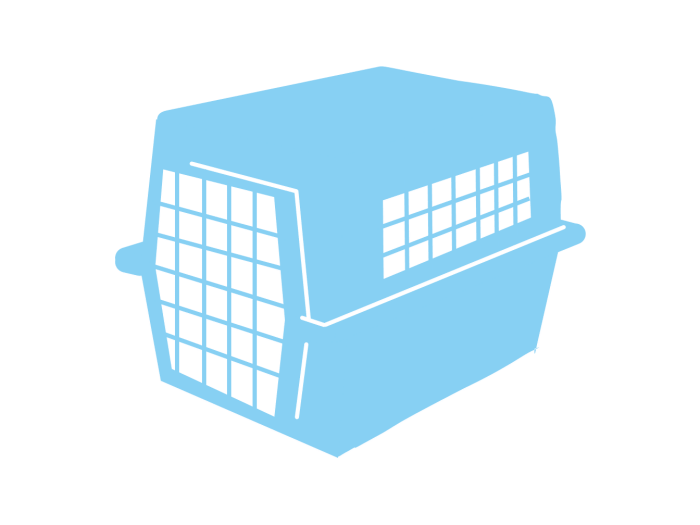
If your pet cage is made of a material like plastic that can withstand air transport (something other than wicker, wood, cloth, or similar) and can be locked, we can accept it as is. We cannot accept pet cages made of wicker, wood or cloth. In such instances, we will require that you either place your cage inside one of our rental cages or transfer your pet into one of our rental cages before we can accept it.
Our rental pet cages cannot be reserved in advance. Please inform an airport staff member on the day of your departure. Please note that since the number of extra-large (size LL) pet cages available is limited, you should contact the Reservation and Information Center in advance if you will require one.
The approximate sizes of our rental pet cages are as follows.
AIRDO rental pet cages (length × width × height)
|
|
|---|---|
| Small | 40cm×55cm×40cm |
| Medium | 50cm×70cm×55cm |
| Large | 55cm×80cm×60cm |
| Extra Large | 65cm×95cm×70cm |
If you are bringing your own pet cage, please check to ensure that it meets the following specifications.
- The pet cage must be made of a sturdy material, such as hard plastic or metal. It must have a roof, and it must be capable of withstanding air transport.
- If it has wheels, they must be either removable or lockable.
- It must have air slits or similar holes on the side to allow air flow.
- It should provide enough space for the pet inside the pet cage to stand, sit, lie down, and turn around.
During the summer season (May 1-Oct 31), we cannot accept pets in double cages or cages with flexible covers draped on top of them, as this could impede ventilation and pose a safety hazard. (Exceptions are made for small birds, hamsters, and similar pets.)
- Each pet cage may contain only one dog or cat. In the case of small birds, up to two birds of the same species may be placed in the same cage (as long as they fit in a medium size cage).
- Drinking water, food, and other items cannot be placed inside the pet cage. Additionally, since we are unable to provide additional food and water after your pet has been checked in, you should ensure that your pet has been given food and water beforehand. Water dispensers that meet the following requirements can remain attached to the cage while it is in our custody.
- Notes:
-
- The water dispenser must be firmly attached to the pet cage.
- The water dispenser must be a drip-bottle dispenser that will not leak due to shaking or vibrations.
Fish, turtles, and insects
Fish (small fish the size of goldfish), turtles (small turtles around 10 cm in size), and insects (such as rhinoceros beetles and stag beetles) must be placed in small containers to avoid causing problems for other passengers. Depending on their size, you may bring up to three such pets on board the airplane, provided that a staff member confirms that the creatures cannot escape and water cannot leak out.
Even if you abide by the restrictions described above, there may be instances in which you cannot bring your pet on board.
- Notes:
-
- The following are some examples.
- Insects which make sounds, such as katydids and bell crickets
- Instances when a container is packed in a way not allowing it to be stowed under the seat in front of you
- Instances when it is judged that your pet(s) will cause discomfort to other passengers
- Pets that require the operation of electrical generators, pumps, or similar devices. (These cannot be stored in the cargo hold either.)
- Amphibians (such as axolotls) and reptiles (such as lizards) cannot brought into the cabin or checked in as baggage.
For more information, please contact the Reservation and Information Center in advance.
Up to 30 cm long × 22 cm tall × 20 cm wide (approximately)
- Notes:
-
- You must stow the container under the seat in front of you.
